

What is a breach of contract?
When a party fails to perform an obligation under a valid contract without a legal excuse for that failure, it is called a breach of contract. Not every failure to perform is a breach, and that distinction is where a lot of disputes actually turn.
If a vendor can’t deliver because of a force majeure event named in the contract (a war, natural disaster, government action, or other event the clause specifically covers), that’s excused non-performance, not breach. Same with impossibility (the subject matter of the contract no longer exists) and frustration of purpose (an unforeseen event guts the entire reason the deal was made, even though performance is technically still possible). A mutual mistake about a material fact can also void the obligation entirely rather than trigger a breach claim.
This distinction changes your entire response. Treating an excused non-performance as a breach means you’re chasing damages you’re not entitled to. Treating an actual breach as excused non-performance means you might miss your notice window or waive rights you didn’t need to give up.
An important thing to note:
Breach of contract is a civil matter, not a criminal one. The only time criminal exposure enters the picture is when the breach is tied to a separate criminal act, like fraud in the contract’s formation. That’s rare, and when it happens, it runs alongside the civil claim rather than replacing it.
The four elements of a breach of contract claim
Before you can call something a breach, you need four things in place. Think of this as the checklist you’d actually run before escalating a dispute or responding to one.
A valid contract existed
Offer, acceptance, consideration, capacity, and a lawful purpose. If any of these is missing or contestable, you don’t have a breach claim. You have a contract formation dispute, and that’s a different fight entirely.
The non-breaching party performed, or had a valid excuse not to
You can’t recover for the other side’s failure if you also failed to hold up your end, unless your non-performance was itself excused.
The other party failed to perform
This has to be a specific, identifiable failure tied to an actual term in the agreement, not a general sense that the relationship isn’t working out.
Damages resulted
Courts and counterparties both want to see that the failure actually cost something. A technical violation with no measurable harm rarely goes anywhere.
Run an incoming claim, or your own grievance, through these four in order. If it stalls on any one of them, you know exactly where your exposure or your leverage sits.
Causes of breach of contract
Most breach disputes in corporate contracts are due to process failures: obligations that weren’t tracked or contract terms that were ambiguous enough for both sides to read differently. Most of these causes are preventable once you know where to look.
The scale of this problem is measurable. World Commerce & Contracting research found that companies lose an average of 9% of annual contract value through poor contract management practices, from missed obligations, overlooked renewal terms, and unmonitored commitments. The best-performing organisations hold that figure to around 3%. The gap between the two is almost entirely a tracking and governance problem, not a drafting one.
Ambiguous or poorly drafted obligations
Terms like “delivery,” “completion,” or “acceptable quality” get left undefined, so both sides can perform exactly as they understood the deal and still end up in a dispute. Fix it at drafting: defined terms, measurable thresholds, explicit acceptance criteria.
Deadlines and thresholds that aren’t tracked.
Renewal dates, SLA thresholds, and cure periods get set once and then left alone. By the time anyone checks them against what’s actually happening, the window to act has often already closed.
Scope that drifts without a formal amendment
Work expands through email approvals or verbal go-aheads, so the contract and actual practice quietly diverge. When performance eventually falls short of the informal understanding, neither side has clean documentation to point to.
A counterparty in financial or operational trouble.
A vendor who can no longer deliver often goes quiet rather than notify you formally. Missed milestones and thinning staff on your account are usually visible before the actual failure is.
Types of breach of contract
Classification isn’t academic. It determines whether you can walk away from the deal or whether you’re stuck performing while you pursue damages on the side.
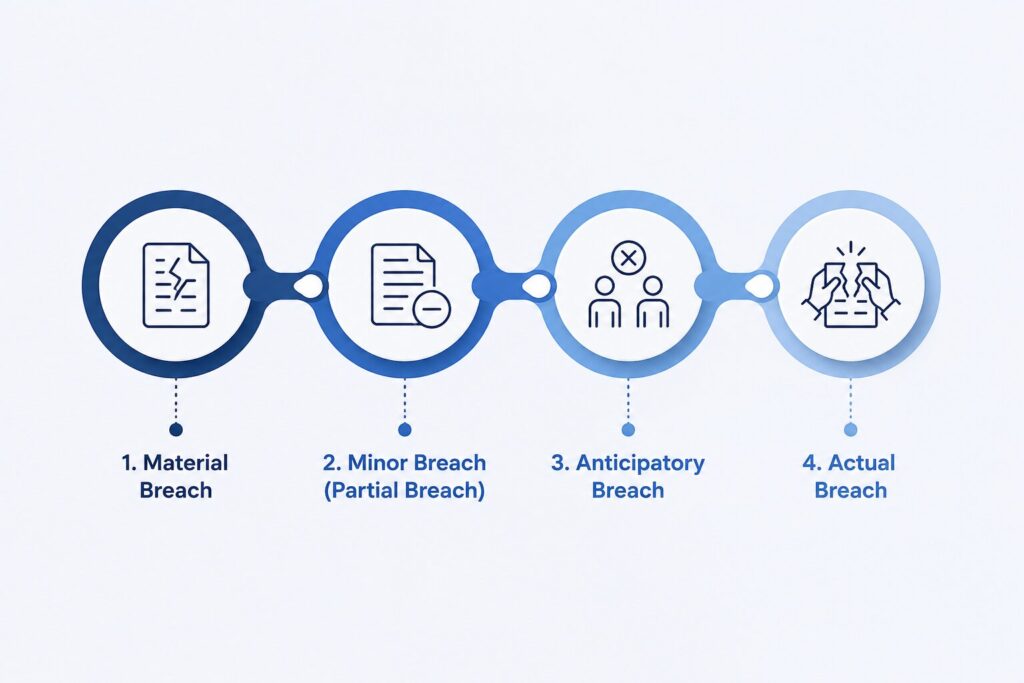
Material breach
This is the one that guts the core purpose of the agreement. Say you’ve contracted with a data processor to handle customer PII under a DPA, and they fail to implement the encryption standards the agreement requires, resulting in an exposure event. That’s not a technical slip. It defeats the entire reason you signed the DPA in the first place. A material breach lets the non-breaching party terminate the contract, walk away from their own remaining obligations, and pursue damages.
Minor breach (partial breach)
The obligation is still substantially met, just imperfectly. For instance, a SaaS vendor guarantees 99.9% uptime in the SLA and delivers 99.7% one month due to a handful of short outages. Annoying, and it might cost you something in lost productivity, but it doesn’t unravel the agreement. With a minor breach, you’re still on the hook to perform your side of the deal. You just get to seek damages for whatever the shortfall actually cost you.
Anticipatory breach
One party makes it clear, before performance is due, that they’re not going to deliver. A cloud infrastructure vendor sends notice that they’re sunsetting a service in your region eighteen months before your contract term ends. You don’t have to wait for the actual failure date to act. You can treat the contract as breached immediately and start lining up a replacement vendor or pursuing remedies.
Actual breach
The deadline passes, and the obligation simply wasn’t met. Straightforward, and it can be either material or minor depending on how badly it misses the mark.
If you misclassify a minor breach as material and terminate the contract anyway, you might find yourself the one in breach for walking away from an agreement you were still bound to perform.
| Type | Definition | Can you terminate? | Can you pursue damages? | Corporate example |
|---|---|---|---|---|
| Material breach | Defeats the core purpose of the agreement | Yes | Yes | Data processor fails to encrypt PII per DPA, causing an exposure event |
| Minor breach (partial breach) | Obligation substantially met but imperfectly | No (you must keep performing) | Yes (for the shortfall only) | SaaS vendor delivers 99.7% uptime against a 99.9% SLA guarantee |
| Anticipatory breach | Party signals in advance they won’t perform | Yes (you don’t have to wait) | Yes (immediately upon repudiation) | Cloud vendor announces service sunset 18 months before contract ends |
| Actual breach | Deadline passes, obligation not met | Depends if it is material or minor? | Yes | Software delivery missed by 60 days with no cure or communication |
How to prove a breach of contract claim
Evidence is where most breach disputes actually get decided, long before anyone sets foot in a courtroom.
At minimum, you want the signed agreement itself, a documented trail of correspondence around the disputed obligation, performance records showing what was actually delivered versus what was promised, and a formal notice of breach sent to the other party. That last one isn’t optional in a lot of contracts. Many agreements specify a notice period and a cure window before you can treat a failure as an actionable breach, and skipping that step can undercut an otherwise solid claim.
This is where contract lifecycle management (CLM) stops being a filing exercise and starts being a litigation-readiness function. A repository that tracks obligations, deadlines, and version history against actual performance data gives you a documented record without having to reconstruct one after the fact, which is usually when the record is weakest.
Statute of limitations is the other piece people underestimate. It varies by jurisdiction and by the type of claim (written contract versus oral, for instance), and the clock generally starts running from the date of the breach or the date the injured party reasonably discovered it. In the US, most states fall somewhere between three and six years for written contracts, though several run shorter and California and New York each have their own specific windows. If you’re dealing with a cross-border agreement, don’t assume your home jurisdiction’s limitations period applies. Confirm it against the governing law clause before you assume you have more time than you do.
Damages and remedies for breach of contract
Damages aren’t one category. Getting the type right changes what you can actually recover.
Compensatory damages
These cover the direct, out-of-pocket cost of the breach. If a vendor’s non-delivery forces you to source the same service elsewhere at a higher price, the price difference is compensatory.
Consequential damages
These go further, covering losses that flow indirectly from the breach, like lost profits from a system outage caused by a vendor’s faulty update. Courts only award these if the losses were foreseeable at the time the contract was signed, so if you’re negotiating a vendor agreement and consequential losses are a real risk, get specific about that exposure in the contract language itself rather than hoping a court agrees later.
Incidental damages
These are the smaller costs of dealing with the breach itself, things like storage fees for goods that arrived late or the administrative cost of sourcing a replacement.
Specific performance
This is a court order forcing the breaching party to actually complete the obligation, reserved for situations where money can’t substitute for what was promised, like unique real estate or one-of-a-kind assets. It’s rare in commercial SaaS and vendor contracts, where substitute performance is usually available, and money damages do the job.
Rescission and restitution
These are used to cancel the contract and return both parties to where they stood before signing, with anything already exchanged handed back.
Here’s the piece that gets skipped almost everywhere
The non-breaching party has an affirmative duty to mitigate. You can’t sit back, let losses pile up, and expect full recovery if a reasonable person in your position would have taken steps to limit the damage. If a vendor breaches and you could have sourced a replacement within two weeks but waited two months for no good reason, a court can reduce what you recover accordingly. This cuts both ways. If you’re defending against a breach claim, the other side’s failure to mitigate is one of your strongest arguments for reducing what they’re owed.
| Remedy | What it covers | Awarded when |
|---|---|---|
| Compensatory damages | Direct out-of-pocket loss from the breach | Breach is proven and measurable |
| Consequential damages | Indirect losses flowing from the breach | Loss was foreseeable at contract signing |
| Incidental damages | Costs of managing the breach itself | Breach is proven |
| Specific performance | Court-ordered completion of the obligation | Money damages are an inadequate substitute |
| Rescission and restitution | Cancels the contract; parties returned to pre-contract position | Fundamental failure of consideration or fraud |
| Liquidated damages | Pre-agreed amount payable on a defined breach | Valid LD clause present and enforceable |
Penalty clauses vs. liquidated damages
These get used interchangeably in casual conversation, and that’s a mistake worth avoiding, especially if you’re the one drafting the clause.
A liquidated damages clause sets a predetermined dollar amount payable if a specific breach occurs, agreed to in advance so both sides skip a costly damages calculation later. Courts will enforce it, but only if it passes a specific test: the amount has to be a reasonable estimate of what the actual loss would be, made at the time the contract was signed, not a number picked to punish or scare the other side into compliance. If a court decides the clause functions as a penalty rather than a genuine pre-estimate of loss, it will refuse to enforce it, and you’re back to proving actual damages from scratch.
A Practical Drafting Lesson
When you’re building a liquidated damages clause into a vendor contract, tie the number to something you can actually justify. Show your work, even informally. A number that looks arbitrary or punitive on its face is the first thing opposing counsel will attack if the clause ever gets tested.
When your company is the one accused of breach
Most breach of contract content assumes you’re the wronged party looking for a payout. In-house legal spends at least as much time on the other side of that equation, defending against claims rather than bringing them.
The ACC’s 2024 Chief Legal Officers Survey, based on responses from 669 CLOs across 31 countries, consistently identifies contract disputes and regulatory exposure among the matters consuming the largest share of in-house legal resources. Defending against a breach claim you didn’t anticipate is expensive in every dimension: time, outside counsel spend, and management distraction.
When a breach notice lands on your desk, triage it the same way you’d want the other side to be triaged if the roles were reversed.
Check the timeline first: Is the claim within the statute of limitations, and does the contract include a notice period or cure window the other party skipped before escalating? A lot of breach claims die on procedural grounds before anyone gets to the merits.
Check for an excuse: Was the failure covered by a force majeure clause, or does it qualify as impossibility or frustration of purpose? These aren’t loopholes; they’re legitimate defenses built into contract law for exactly this situation.
Check their performance: Did the party claiming breach actually hold up their own end of the deal? A counterparty who was late on payments has a weaker position claiming your delivery delay was a material breach.
Check for mitigation: If they’re claiming significant damages, did they take reasonable steps to limit those losses, or did they let the number run up?

Real-world breach of contract cases
Most breach of contract cases never reach a published opinion; they settle or get resolved through negotiation, but a handful of well-known cases still shape how courts think about the concepts above.
Hadley v. Baxendale is the case that gave us the foreseeability rule for consequential damages. A mill’s crankshaft broke, and the carrier delayed delivering it for repair, but the mill hadn’t told the carrier that the entire operation would shut down without it. The court ruled the carrier wasn’t liable for the mill’s lost profits because that loss wasn’t something the carrier could have reasonably anticipated. It’s the reason foreseeability shows up as a requirement for consequential damages today, and it’s a good argument for spelling out unusual downstream risks in your contracts rather than assuming a court will read them in.
Read full decision: Hadley v. Baxendale, 9 Ex. Ch. 341 (1854)
Jacob & Youngs v. Kent dealt with a builder who installed a different, functionally equivalent brand of pipe than the one specified in the contract. The court found this was a minor breach rather than material, since the deviation didn’t affect the building’s value or function, and ordered damages for the price difference rather than allowing the owner to refuse payment entirely. It’s the case most often cited for the distinction between a breach that undermines a contract’s purpose and one that’s a technical deviation from the letter of it, which is exactly the material-versus-minor line in-house teams have to draw constantly.
Read full decision: Jacob & Youngs, Inc. v. Kent, 230 N.Y. 239 (1921)
Hochster v. De La Tour is the foundational anticipatory breach case. An employer told a courier, before his employment term began, that his services wouldn’t be needed after all. The court held the courier didn’t have to wait for the start date to pass before suing; he could treat the contract as breached the moment the employer made the repudiation clear. That’s the doctrine behind every anticipatory breach scenario you’ll run into with a vendor who pre-announces they’re walking away from a deal.
Read full decision: Hochster v. De La Tour, 2 Ellis & Bl. 678 (1853)
Preventing breach of contract at the clause level
“Draft clear contracts” is true and mostly useless as advice. The more practical version is building specific mechanisms into the agreement that catch problems before they become disputes.
Notice-and-cure periods
Give the breaching party a defined window to fix the problem before the other side can terminate or sue. This protects both sides from disputes over minor, fixable issues escalating unnecessarily, and it’s standard in most enterprise vendor agreements for exactly that reason.
Escalation clauses
Move disputes through internal negotiation or executive-level discussion before either side can go to mediation or litigation. Cheaper and faster than the alternative, and it preserves the relationship if the underlying issue is fixable.
Step-in rights
These let you take over performance of a critical obligation yourself, or bring in a third party to do it, if a vendor fails to deliver, particularly useful in contracts involving infrastructure or services your business can’t function without.
Force majeure carve-outs
This should be scoped to the actual obligation, not copied wholesale from a template. A generic force majeure clause covering “acts of God” doesn’t help much in a data processing agreement where the real risk is a subprocessor failure or a regulatory change.
How MatterSuite helps you catch breach before it’s a breach
Go back to the DPA example earlier in this piece. The processor didn’t wake up one day and decide to skip the encryption requirement. Somewhere along the way, that obligation stopped being tracked against a deadline, and nobody noticed until the exposure event forced the issue.
That’s the pattern behind most breach disputes legal teams actually deal with. Not bad faith, missed obligations. A renewal date buried in a PDF. An SLA threshold nobody was checking against actual uptime. A cure period that lapsed because no one was counting the days.
MatterSuite Contract Lifecycle Management software tracks contract obligations against their actual deadlines, not just the calendar reminder someone set and forgot. When an SLA threshold, a renewal window, or a cure period is approaching, your team sees it before it becomes a notice of breach instead of after. And when a dispute does happen, the correspondence, versions, and performance history already in place if a dispute does happen anyway.
See how MatterSuite tracks contract obligations → Explore MatterSuite CLM
Frequently asked questions
It’s a failure that defeats the core purpose of the agreement, giving the non-breaching party the right to terminate, stop performing, and pursue damages. The classification fight usually comes down to how central the missed obligation was to the deal, not how badly it was missed.
A material breach justifies termination. A minor breach means the obligation was substantially performed but fell short, so you keep performing and claim damages for the shortfall. Terminating over what turns out to be a minor breach can put you in breach yourself.
One party signals, before performance is due, that they won’t deliver. You can treat the contract as breached right away, stop your own performance, and start pursuing remedies or lining up a replacement instead of waiting for the deadline to pass.
Compensatory damages cover direct losses, consequential damages cover foreseeable indirect losses, incidental damages cover the cost of managing the breach, and liquidated damages apply where a valid clause exists. Specific performance is available in limited cases. The non-breaching party also has a duty to mitigate, so letting losses pile up unnecessarily reduces what you can recover.
A liquidated damages clause is a pre-agreed, good-faith estimate of the loss a specific breach would cause, and courts enforce it when the estimate is genuine. A penalty clause sets an amount meant to punish or coerce, and most courts won’t enforce it. Tie any liquidated damages figure to a number you can justify.
It depends on jurisdiction. In the US, most states allow three to six years for written contracts, counted from the breach or its discovery. California allows four years, New York allows six. For cross-border agreements, check the governing law clause before assuming you have more time than you do.
Locate the signed contract and confirm the version in dispute. Check the notice requirements and any cure window. Consider whether force majeure, impossibility, or frustration of purpose applies. Assess the claimant’s own performance and whether they mitigated their losses. Preserve correspondence, version history, and performance data before responding.
It tracks deadlines, SLA thresholds, renewal windows, and cure periods against actual performance, and alerts your team before those windows close. It also keeps a version and correspondence history ready if a dispute happens anyway.