

Key Takeaways
- Contract management and contract lifecycle management aren’t interchangeable. CLM is what happens when contract management gets organized into a repeatable, ownable process instead of staying ad hoc.
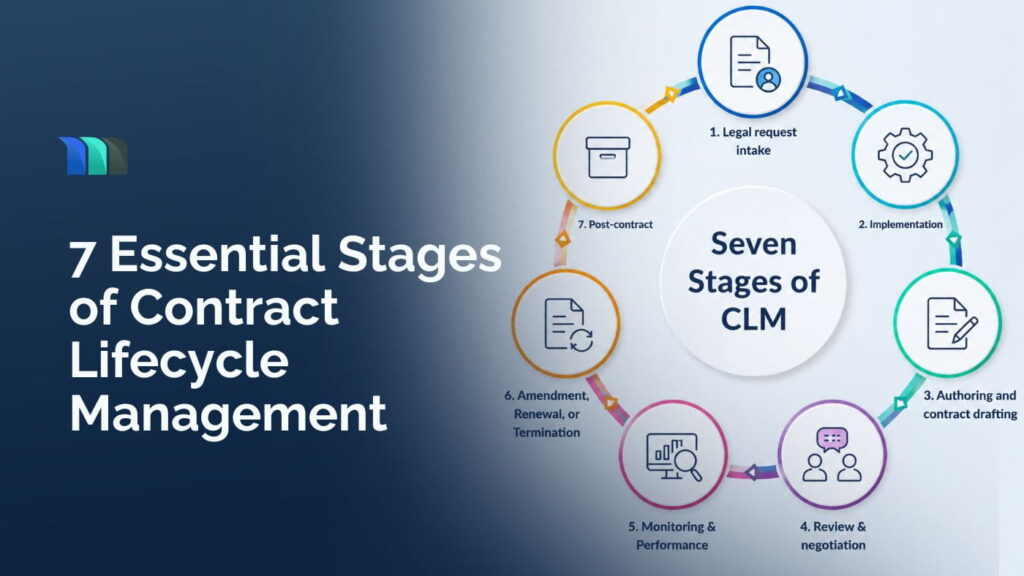
- Every contract moves through the same seven stages, from planning through post-contract close-out, whether or not anyone’s tracking it. Naming those stages is what makes it possible to spot where a specific agreement is stuck.
- Most contract problems trace back to one root cause: information that lives in someone’s memory or inbox instead of a shared system.
- Purpose-built CLM software addresses that root cause directly by making drafting, tracking, and renewals a function of the system rather than something one person has to remember to do.
For businesses and enterprises, contracts make up more than half of the operations. Be it vendor agreements, client engagements, employment terms, or licensing, they are the lifeline of the business as they define the commercial and legal boundaries. Even after being so central to any business, contracts are often not managed properly.
Contract Lifecycle Management (CLM) takes care of this directly. Rather than treating each contract as an isolated document to be produced and filed, CLM manages every contract through a structured process, which can be repeated every time. This helps generate value at every phase, not just at signing. For legal operations teams and General Counsel offices managing large contract volumes, understanding where that process begins, where it ends, and what happens at each of the contract lifecycle stages in between is the foundation of effective contract management.
What Is Contract Management?
Contract management covers everything that happens to an agreement between the moment it’s first requested and the moment it’s closed out, renewed, or terminated. That includes drafting and negotiating the terms, routing the document for approval, executing it, and then making sure both sides actually manage the contract the way they said they would.
That last part is where most contract management breaks down. Getting a signature is the easy half. Tracking obligations, deadlines, and performance for the life of the agreement is the half that actually protects the business, and it’s the half that gets skipped when the contract management process is treated as a filing exercise instead of an ongoing process.
Contract Management vs. Contract Lifecycle Management
These terms are often used interchangeably, and it makes sense why they are used interchangeably. Contract management is a bigger and broader term than contract lifecycle management. Anything that is even remotely associated with the contracting process falls under contract management
Contract lifecycle management, or CLM, is a specific way of doing contract management. It means organizing every contract through the same defined phases, with clear ownership and consistent workflows at each one, usually supported by software that moves the contract along automatically instead of relying on someone remembering to forward an email. Every CLM process is a form of contract management. Not every contract management process qualifies as CLM. A team still emailing Word documents back and forth is doing contract management. They are not doing contract lifecycle management, even if they’d like to call it that.
The Stages of Contract Management
Contract management consists of various stages. Whether you call them contract stages or CLM stages, dividing the process makes it easier to see why and where a specific agreement gets stuck and who should be held responsible for it.
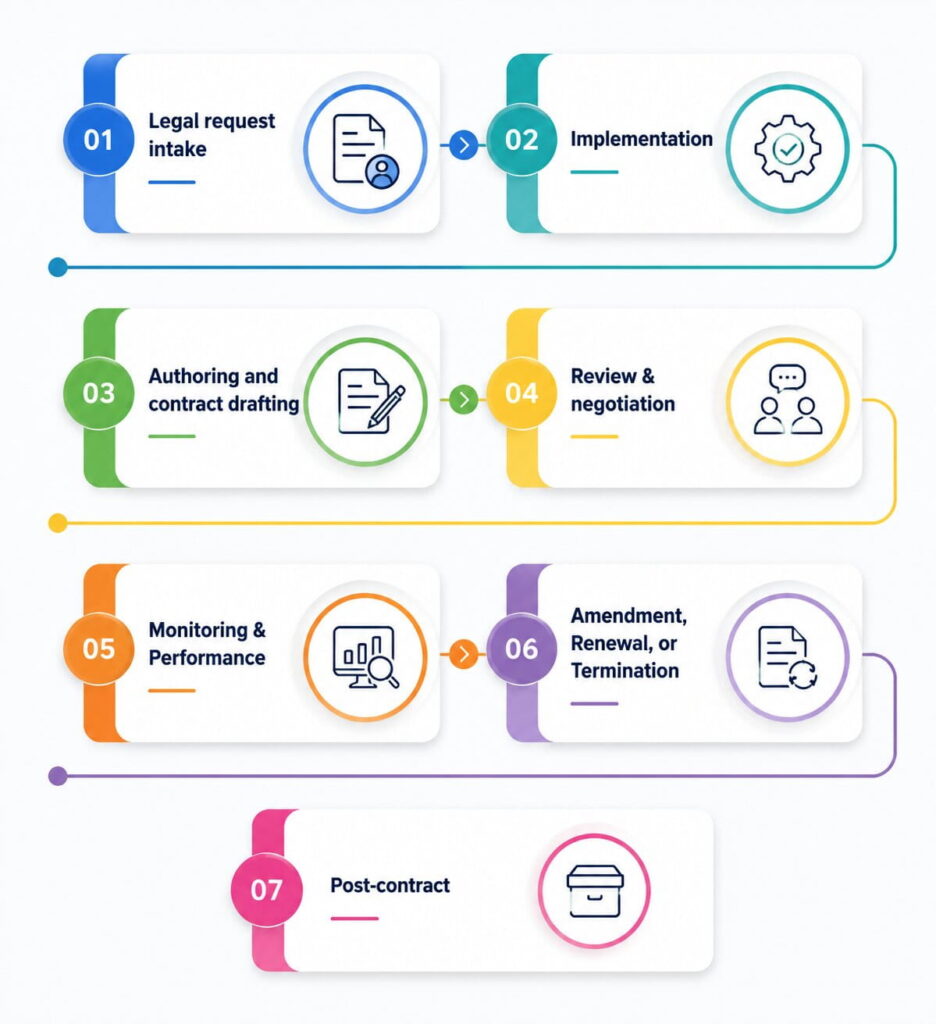
Here are the seven stages of contract lifecycle management :
1. Legal request intake
Every contract begins with a request, which makes it important to understand the reason why the contract is being prepared. This means answering a handful of concrete questions. These are some of the questions that should be answered before the contract is prepared.
- What types of agreements does the organization deal with, and roughly how many of each? Which of those are repeatable enough to standardize into a template?
- Who has final approval authority, and does that authority change based on contract value or risk?
- What data needs to be tracked on every contract, and where does it get stored so it can actually be found later?
Knowing answers to these questions helps keep the process structured and makes it easier to follow the next steps.
2. Implementation
Once the plan exists, it has to actually get put into practice. That usually means selecting and deploying contract management software, migrating existing agreements into a central repository, and training the people who will use the system day to day. The training piece gets underweighted constantly. A well-designed system that nobody understands how to use will get abandoned in favor of the same email threads and shared drives it was meant to replace.
3. Authoring and contract drafting
This is the contracting phase where a specific agreement starts to take shape, either pulled from an existing template or built from scratch for something unusual. For standard situations, most of the work is picking the right template and filling in the specifics. If the conditions are non-standard, the responsible person starts with a comparable prior agreement and adapts the terms, using the same compliance requirements. Getting the essential elements of the contract right at this stage is what keeps the draft from needing major rework later.
E-signature tools come in handy at this stage because the process becomes a lot easier if the signing workflow is set up earlier in the process. This helps in avoiding a scramble once the terms are finalized.
4. Review & negotiation
Once the contract draft is ready, it is then circulated internally and sent to the counterparty for negotiation. Feedback comes back as comments, redlines, and suggested revisions. This means the contract has to be updated in rounds until both sides land on acceptable terms. Having version control at this point matters the most because there are multiple versions of the contract now, which can be a source of confusion.
5. Monitoring & Performance
This is what’s often called post-award contract management, where the agreement is live and doing what it was written to do, assuming someone is actually watching it. That means monitoring performance against whatever was promised: delivery timelines, payment schedules, service levels, whatever the contract’s specific obligations happen to be. Having a set of clear milestones before the process starts makes this monitoring possible. Without these clear milestones, “performing as expected” often becomes a subjective judgement call.
6. Amendment, Renewal, or Termination
After the agreement is signed and live, there comes a point where a decision to renew it, renegotiate, or let it lapse has to be made. This stage is known as the pre-renewal stage, and here is where things are deliberated and a decision is made. Having a clear understanding and discussion is important in this stage because otherwise the contract would go into auto-renewal. All the involved parties come together and evaluate how the agreement performed and if there are any terms that need to be renegotiated.
7. Post-contract
When an agreement ends, whether through completion, termination, or non-renewal, there’s still work left. Final invoices need to be settled. Termination conditions need to be confirmed as met. The contract needs to be archived somewhere it can still be found if a question comes up later. It’s also worth a short retrospective: did this agreement deliver what was expected, and is there anything about how it was negotiated or managed that should change next time? Skipping that retrospective means the same avoidable problems tend to resurface in the next contract with the same counterparty.

Common Contract Problems
Before fixing the process, you need to know exactly where it breaks. These are the problems that show up most often:
- Version control – Redlines move across email threads, shared docs, and printed markups, and nobody owns reconciling them. The copy that eventually gets signed isn’t always the one everyone thinks they agreed to.
- No standard language – Without an approved clause library, every contract gets drafted a little differently, even when the underlying deal is nearly identical to one signed last month. That inconsistency makes contracts harder to review and harder to compare later.
- Approval bottlenecks – A contract sits waiting on one person’s sign-off with no backup approver and no escalation path. If that person is out sick or just slow to respond, the deal stalls with nobody else even aware it’s stuck.
- No audit trail – When a question comes up later about who approved a contract, on what date, and under what terms, the answer is often buried in someone’s inbox instead of logged anywhere searchable.
- Obligations tracked in someone’s head – A renewal date or a reporting requirement lives in one person’s memory instead of a shared system. The moment that person changes roles or leaves, the obligation goes untracked.
- Manual data entry – JPMorgan’s $6.2 billion “London Whale” loss traced back to a single spreadsheet formula error. The same exposure exists at a much smaller scale in any contract: a mistyped figure or a bad copy-paste becomes legally binding the moment it’s signed.
How MatterSuite CLM Simplifies Contract Management
The problems above share a common thread: they happen when contract management depends on people remembering things instead of a system tracking them. MatterSuite CLM software is built to close that gap, from the moment a contract is drafted to the moment it’s up for renewal.
Drafting starts from a template, not a blank page. MatterSuite pulls from a central clause library of pre-approved language, so a standard NDA or vendor agreement doesn’t need to be written from scratch every time. Fields like client name, fee amount, and key dates auto-fill from existing matter and client records, cutting out the repetitive parts of drafting entirely.
Every version stays visible and recoverable. Full version history with side-by-side comparison means there’s no more guessing which draft has the agreed-on liability cap. Every edit, review, and approval is logged with a timestamp and tied to the person who made it.
Signing and storage happen in the same place. MatterSuite integrates with e-signature providers and tracks status from sent through signed, with the executed copy and its full audit trail stored automatically.
Renewals get flagged before they become a problem. Automated alerts for expiry dates and key milestones go out to the right people with enough lead time to actually act, whether that means renegotiating, renewing, or letting a contract lapse on purpose instead of by accident.
Moving Forward
Contract management involves enough moving pieces that mapping the process cleanly can feel like a bigger project than it’s worth, particularly for a team that’s never documented its current practices at all. It’s worth doing anyway. The organizations that treat contract management as seven distinct, ownable stages catch problems while they’re still small: a stalled approval, a missed renewal date, an obligation nobody’s tracking.
Whether that structure comes from a documented process, dedicated software, or some combination of both matters less than actually having it. What matters is that someone can look at any contract, at any point in its life, and know exactly where it stands and who’s responsible for what happens next.
Frequently Asked Questions (FAQs)
The seven stages are planning and intake, implementation, authoring and drafting, review and negotiation, monitoring and performance, renewal and termination, and post-contract. Each stage has its own owner and its own way of getting stuck, which is why breaking the process down this way matters more than treating a contract as one long, undifferentiated task.
Planning and intake capture what’s being requested and why. Implementation puts the systems and templates in place to handle it. Authoring and drafting build the actual agreement. Review and negotiation is where redlines go back and forth until both sides agree on terms. Monitoring and performance track whether obligations are actually being met once the contract is live. Pre-renewal is the decision point: renew, renegotiate, or let it lapse. Post-contract closes everything out: final invoices, archiving, and a short retrospective on how the agreement performed.
Redlining is the back-and-forth editing process during review and negotiation, where each side marks up proposed changes to terms, usually through tracked changes or comments, until both parties land on language they’re willing to sign. Without version control, redlining is also where contracts most often get confused, when edits are scattered across multiple email threads instead of a single reconciled draft.
Signing marks the start of the monitoring and performance stage, not the end of the process. Once a contract is executed, someone needs to track the obligations it created: payment schedules, deliverable dates, renewal notice periods, service levels. This is sometimes called post-award contract management, and skipping it is how teams end up missing deadlines or discovering an auto-renewal clause after it’s already kicked in.
Responsibility usually shifts across the contract’s life. Legal or the requesting business unit typically owns intake and drafting; negotiation may involve legal alongside sales, finance, or procurement depending on the deal, and day-to-day monitoring often falls to whoever manages that vendor or client relationship, not necessarily the person who negotiated it. Without a clearly assigned owner at each stage, obligations are the first thing to fall through the cracks.
CLM software replaces manual tracking with a system that handles the parts most likely to get missed by hand: routing contracts for approval based on value or risk, storing every version so nobody’s guessing which draft is current, flagging renewal and obligation deadlines before they pass, and keeping an audit trail of who approved what and when.
The most frequent ones are version control problems, no standard clause language, approval bottlenecks with no backup reviewer, missing audit trails, obligations that live in one person’s memory instead of a shared system, and manual data entry errors, which carry real risk even at small scale.
Standardizing templates and approved clause language removes a lot of the inconsistency at the drafting stage. Centralizing contracts in one searchable repository fixes the visibility problem most teams don’t realize they have until they need a document fast. Automating renewal and obligation alerts takes tracking off individual memory. And treating each of the seven stages as its own accountable step, rather than one long undifferentiated process, makes it possible to spot exactly where a specific contract is stuck.