


Legal departments in most businesses these days are at capacity. There is a growing pressure to keep everything in control, from outside spend to matter volumes, while the budgets for the entire department stay the same. The recent surveys also reflect this gap. A report by the Thomson Reuters Institute’s 2026 State of the Corporate Law Department showed that 86% of the GCs who participated in the study revealed that their department provides a significant contribution to the business, but only 17% of the C-suite executives are in agreement.
This gap is the reason why ROI measurement matters the most in this ever-increasing demand to streamline operations, mitigate risks, and deliver results with unmatched efficiency. The same report showed that 82% of the legal departments do not measure the ROI they get out of the technology they have deployed. Without calculating the ROI, efficiency just stays on paper and is not an actual result.
When legal departments start measuring ELM ROI, they realise the opportunities for financial savings, productivity gains, and risk reduction within the department. This eventually leads to results that show up in reduced counsel spend, more hours from manual work, and fewer compliance gaps.
What Is ELM Software ROI?
ROI means Return on Investment, therefore, ELM software ROI means the return the entire legal department gets after ELM software is deployed. The return is compared to the money spent on running the software. That is how you understand if using the software is beneficial for the department. While calculating ROI, you can see direct impact on cost savings, outside counsel spend, productivity gains, and risk reduction, given that the ELM software is running smoothly and is aligned with business goals.
When we talk about cost savings and business value, we have to understand both of them are different and equally important. Talking about cost savings to your CFO is easy, as they are easy to calculate and defend. It’s just a figure: money spent before v/s money spent after. Business value, on the other hand, has a broader scope and includes a range of things the department would struggle to put a single number on, such as faster decision-making and better retention for lawyers.
A practical way to frame the calculation:
ELM ROI = (Financial Savings + Productivity Gains + Risk Reduction Value) ÷ Technology Investment × 100
Note: This isn’t an official industry formula but a working model for organizing the calculation.
Why Legal Teams Need to Measure Technology ROI
Rising pressure and more scrutiny than ever before: Outside counsel rates keep getting higher with time, outpacing inflation, and legal departments need to provide a defensible answer when finance asks what the technology spend is actually buying.
Spend visibility has become a baseline expectation: With growing complexity in the legal work, it has become increasingly important for legal teams to be able to show where the legal spend goes.
Legal needs a way to prove its value to the rest of the business: When the right tech is deployed, and ROI data is always available for reference, every executive conversation is evidence-backed.

How to Calculate ROI of ELM Software
1. Calculate Cost Savings
Outside counsel spend typically provides the clearest ROI signal in most departments. Starting from the department’s current process, rather than an industry-wide percentage, is more defensible. This approach makes sense because departments with fully manual invoice review, and those lacking systematic flagging of billing guideline violations or automated rate enforcement, have a lot to gain from automation, as every unreviewed invoice can be a potential leak.
The current annual outside counsel spend is the starting point. For a specific department, take this amount, the ACC’s 2025 benchmarking report says the median is $1.1 million, and estimate the percentage that goes through manual, unflagged review. This percentage represents the department’s actual exposure. An e-billing platform with automated guideline enforcement is designed to close this exposure, and then there’s also invoice leakage caught by automated bill review or reduced administrative headcount needs.
2. Measure Productivity Gains
Productivity gains are measured in hours, and to convert them to dollars, you multiply the hours saved by a fully burdened hourly rate; it’s that straightforward; this conversion is easy.
The categories worth tracking:
- Time saved each week on reporting and admin tasks
- Time to approval is shorter now
- Redundant work is minimized across different matters
Harsco Corporation achieved a 237% ROI using Thomson Reuters Legal Tracker’s e-billing functionality over 12 months. Improved invoice review contributed 76% of system cost in savings, and time savings added another 147%. This result, audited and actual, provides a reference point for the potential of a mature e-billing implementation.
3. Measure Risk Reduction
Risk reduction may be tough to quantify in dollars, but it’s not invisible, and its value appears in various forms, including:
- Missed compliance deadlines are fewer
- Audit trails are now faster and more complete
- Detecting contract or matter issues early on is crucial, as it prevents disputes from arising in the first place, and this typically
Departments in financial services and pharma build risk-adjusted value models. These models estimate the cost of exposure a platform helps avoid, using probability weighting. It’s a complex calculation, more than most departments need initially, but knowing it exists can be useful when a board or audit committee asks questions.
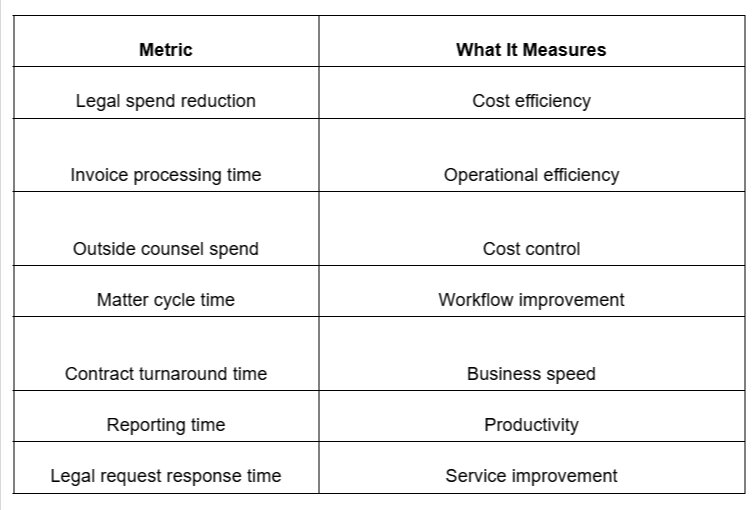
Key Metrics to Measure ELM Software ROI
How to Build a Business Case for Legal Technology Investment
1. Identify current legal challenges
Today’s reality is manual processes, a lack of spending transparency, high fees for outside counsel, and sluggish reporting. Every ROI calculation relies on this baseline, as it provides the necessary comparison point to measure improvements against.
2. Define Expected Business Outcomes
The goal is to express challenges in terms of outcomes that non-legal executives can understand, such as reducing costs, speeding up workflows, making more informed decisions, and enhancing compliance.
3. Calculate Total Investment
Total costs go beyond the software license, covering implementation, training, and change management, which is crucial for team adoption of new workflows. This business case often omits these, leading to an understatement of the real cost and an inflated ROI later on.
4. Present ROI to Stakeholders
Various stakeholders focus on different aspects of the same data. A COO is interested in workflow and efficiency. The CFO looks at cost savings, while a General Counsel considers both, along with risk reduction. It’s more efficient to create the business case with these audiences in mind, making the presentation easier, rather than having to adjust it for each conversation.
ELM Software ROI Example: Before and After Implementation
ELM software yields a significant return on investment, as seen in the difference between pre and post-implementation. The Harsco Corporation case is a real-world example. It had manual invoice review, line by line, before implementing e-billing through its matter management platform. No systematic way existed to catch billing guideline violations before payment. After implementation, over 12 months, Harsco documented a 237% ROI, nearly 2.5 times the cost of the system; this came from improved invoice review savings and direct time savings from automated routing and approval.
It’s a genuine audited figure, published and not a projection, which makes it worth citing directly, rather than using round numbers in a hypothetical scenario.
Common Mistakes When Calculating Legal Technology ROI
Calculating ROI for legal technology is tricky, and many people get it wrong.
- Measuring just the software cost is misleading. Implementation, training, and change management costs are also important and leaving them out makes the ROI look better than it’s.
- Ignoring productivity gains. Cost savings are easy to track. Hours recovered often aren’t tracked at all, and that’s a problem. A real part of the return goes uncounted because of this.
- Not tracking baseline metrics before implementation. Tracking baseline metrics is a must before implementation; otherwise, calculating “after” improvement won’t be credible. You need a “before” number. This step has to occur before the new system goes live.
- Ignoring long-term operational value. Year-one savings and year-three savings aren’t the same, because as people use the platform more, it gets adopted deeper into the department and more workflows are moved onto it. This means a single-year ROI calculation can miss the real value that adds up over time.
How ELM Software Creates Measurable Value for In-House Legal Teams
ELM software brings measurable value to in-house legal teams. Better resource allocation, more accurate reporting, faster matter resolution, and improved legal spend management are key areas where this value consistently shows up.
MatterSuite focuses on providing legal teams with a single, accurate view of legal spend and matter status. This approach eliminates the need to manually reconstruct that view each reporting cycle. It’s crucial to have reliable baseline and ongoing data for ROI calculations. A platform that can’t produce clean numbers complicates the measurement exercise, regardless of its other strengths.

Factors to Consider Before Investing in Legal Technology
Investing in legal technology requires careful consideration of several factors
What specific problem is this solving?
Understanding and naming the problem first sets the expectation for it. If a software solution is deployed to fix outside counsel spend visibility, it will be evaluated differently than the one which was bought for matter tracking.
How mature the department’s current process already is.
Evaluating the maturity of the process on which the department is currently running helps understand which parts actually need to be changed. If your department is running on spreadsheets and emails, there is more room for improvement compared to a department which already has partial automation in place.
How well the platform integrates with existing systems.
It is important to find a platform that connects well with the systems that the department already uses. Integrations for finance, HR, and document management have a direct impact on implementation cost and how much manual work the platform can potentially help remove from the process.
Whether the team will actually adopt it.
Getting a legal tech solution for the department is as important as finding the right one for your department, and most ROI projections often fail to materialize this. The platform should be easy to adopt and should work towards the business goals. Otherwise, the platform cannot produce savings on its own.
Whether it scales with the department.
Scalability is an important factor that most departments often forget to consider before buying software. While buying the software, you have to remember that it might need replacing when the department grows in size. If it is not accounted for initially, it just adds a second implementation cost.
ELM ROI Calculator Template
A simple way to structure the math:
ROI (%) = (Total Annual Benefits − Total Software Investment) ÷ Total Software Investment × 100
Where Total Annual Benefits = Cost Savings + Time Savings (converted to dollar value) + Risk Reduction Value.
Our take
Calculating the ROI of an ELM software is directly related to the measurable business value it brings to the department, which is why it is crucial to understand that the strongest ROI case doesn’t just include software savings. It also covers other important aspects such as reduced legal spend, recovered hours, faster workflows, better visibility, reduced risks, and compliance gaps.
So, before thinking about getting a legal tech solution for your business, legal teams should always start with establishing clear baseline metrics, defining what results they are expecting and what actually matters to them. Once this is done, it becomes fairly easy to track the same KPIs after implementation. This makes the process not only transparent but also makes it easier to defend the technology cost and what the department gains from using it.
The ultimate goal should not be to increase your ROI percentage. It should be about painting a clearer picture of how the legal tech solution is improving after the implementation and how it contributes to the business goals. With data and evidence, the C-Suite finds the confidence to keep investing in the right technology. ELM software, in today’s time, is more than just an investment. It brings efficiency, cost control, and better decision-making.
Frequently Asked Questions
To calculate the return on investment, add financial savings, productivity gains in dollar terms, and the value of risk reduction, then divide that sum by the total investment in technology and multiply by 100.
Several key performance indicators are used to measure the efficiency of a legal department, including legal spend reduction, the time it takes to process invoices, outside counsel spend, matter cycle time, contract turnaround time, reporting time, and legal request response time.
Current challenges and baseline metrics are the starting point. Expected outcomes need to be defined in business terms. The full investment, including implementation and training, must be calculated. Then, the presentation should be tailored to each stakeholder’s concerns, what the CFO, COO, and executive leadership actually care about.
Measurable value is created for in-house legal teams through the use of ELM software, which helps them manage their work and expenses. Better spend visibility, faster matter resolution, and more accurate reporting all contribute, and lawyer time is freed up from administrative work too.
The key factors include business goals, current process maturity, integration requirements, adoption challenges, and scalability.
To make comparisons meaningful, the same baseline metrics are tracked before implementation: outside counsel spend and invoice processing time, as well as matter cycle time, reporting time, and also legal request response time, all measured consistently.

