
As a legal professional, if you have ever wondered what the difference is between a legal matter and a legal case, then you are not alone. In corporate and law firm environments, the terms legal matter and legal case are used interchangeably. Sometimes, a contract review will get called a “case,” and a dispute that never made it to the court will still be tracked like one.
The confusion is understandable, but it is not harmless. Although they are related, they have different meanings. Mixing these two can lead to misunderstanding around scope, responsibility, and management of legal work.
Let’s slow down and break these two apart.
Why “legal matter” vs. “legal case” is confusing
The way these terms are used casually is partially the reason for confusion. Anything even remotely legal gets labeled as a “case.” Many tools and templates use these terms so loosely that the line that differentiates them starts to blur.
Another reason for this confusion is that legal work is rarely linear. Something that starts as a routine request can transform into something that requires escalation to the court. A harmless disagreement can turn into litigation. Even with such changes, involved parties might still call the original work a “case.”
To understand the difference, it helps to define each term clearly.
What Is a Legal Matter?
Legal matter is the term used to describe any issue, task, or situation that needs legal attention or judgment. It is a broad term and encompasses all kinds of legal work.
Legal matters mostly pertain to advisory or preventive work, which may be ongoing or transactional in nature. The important thing to note here is that it doesn’t necessarily require the involvement of courthouses.
Common examples of legal matters include:
- Contract drafting and review
- Regulatory and compliance advisory
- Employment-related issues
- Intellectual property filings and renewals
- Internal investigations
- Legal support for business transactions
Simply put, a legal matter is just a unit of the entire legal work. It represents an issue, request, or obligation that the legal team is responsible for managing.
Most legal matters are addressed internally. They either go through negotiation or are managed by attorneys without having to escalate them into dispute or litigation.
What Is a Legal Case?
Unlike a legal matter, a legal case is specific in nature. It is a type of legal matter that involves a formal dispute that needs to be escalated. A resolution is reached through a court, tribunal, or arbitration forum
When the involved parties are not able to resolve an issue through informal means, they seek a legally binding decision. This is when a legal case arises. A legal case follows a structured process that is dictated by procedural rules and has a clearly defined path, from beginning to end.
Common examples of legal cases include:
- Civil litigation
- Criminal prosecutions
- Arbitration proceedings
- Consumer or commercial disputes filed before legal forums
Legal cases generally involve pleadings, hearings, legal representation, and an outcome such as a judgment, settlement, or arbitral award.
Legal matter vs legal case: key differences
Before we compare legal matters and legal cases side by side, it is worth pausing on one important point: these terms do not define opposing types of work. They belong to different levels of structure within legal work.
A legal matter needs to be attended to, while a legal case needs to be handled once it enters a formal process. The former is broader and more flexible, while the latter needs to be governed by a procedure that makes it narrower.
This is one of the reasons why an issue can move between the two. For instance, a contract dispute might start as a legal matter and continue being that for months before becoming a legal case, if formal action is required.
Looking at the differences side by side makes it easier to see where responsibilities, workflows, and expectations begin to change.
| Aspect | Legal Matter | Legal Case |
|---|---|---|
| Definition | A broad category of legal work requiring legal attention | A formal dispute requiring adjudication |
| Scope | Advisory, transactional, compliance, or dispute-related | Limited to disputes and proceedings |
| Court involvement | Not required | Required |
| Nature of work | Preventive or supportive | Adversarial |
| Duration | Can be short-term or ongoing | Follows a defined legal timeline |
| Outcome | Advice, compliance, resolution, or risk mitigation | Judgment, settlement, or award |
| Examples | Contract review, compliance advisory, IP filings | Lawsuits, arbitration, criminal trials |
Which One Applies in Practice?
Treating legal work as a matter or case depends largely on the nature of the work. The difference between the two can be seen clearly through some real-life examples.
Situation 1: A contract that doesn’t stay routine
A vendor contract needs to be reviewed. Lawyers look into the pricing, liability, and termination terms. According to the data collected, they suggest changes and negotiate language with the other side. At this point, the work is a legal matter. It is still a routine legal involvement that needs tracking, but no formal process. There is no involvement of an external forum, deadlines, or filings yet.
Later, it was found out that the vendor failed to meet its obligations. The contract is reviewed again, notices are drafted, and legal advice is given on the next steps. Even though the situation is more serious than before, it is still being treated as a legal matter. The reason is that the issue is still being addressed through negotiations and internal decision-making.
Situation 2: An internal issue that escalates
In a workplace, an employee raises a complaint. The HR brings the lawyers in early. The team reviews company policies, documents, and recommends a corrective action. At this stage, the issue will be addressed as a legal matter as it is being managed internally. The employee later files a claim with labor authorities. The same issue is now treated as a legal case. The legal team responds formally, meets the procedural requirements, and participates in hearings. The facts are the same, but as soon as an external legal forum is involved, the work shifts from matter management to case management.
Situation 3: A dispute that begins as a legal case
A law firm gets a request from a client who has received a court notice. Right from the start, the work is treated as a legal case. The legal team focuses on pleadings, collecting evidence, fillings and compliance with the rules set by the court.
In a situation like this, there is no preliminary stage or legal matter stage that needs to be managed internally. The legal work is entirely governed by the formal procedure from the beginning. While the seriousness of the matter is that of a legal matter, it is handled as a legal case throughout the lifecycle because it has entered an external forum.
Why This Distinction Matters in Real Legal Work
In law firms, legal matters easily get mistaken for legal cases and vice versa. Because of that, everyday legal work becomes harder to manage than it needs to be. Teams lose clarity on what requires formal oversight and what needs to be just tracked and followed up on. This affects the prioritization of tasks and even how risk is evaluated.
For in-house teams, addressing routine work as “cases” may cause unnecessary friction and complexity. For law firms, treating pre-litigation work and active cases the same way often affects accountability and blurs the workload visibility. Understanding the distinction between the two helps legal teams apply the right level of structure and judgment, saving time and effort.
Why the Same Software Can’t Handle Both Matters and Cases Well
Legal matters and legal cases don’t just differ in definition. They differ in how they progress, how long they last, and how teams work on them. Because they are different in so many aspects, the tools used to manage them cannot be identical either.
A legal matter often begins as a review or a request that evolves with time. As it evolves, more stakeholders are involved. It doesn’t follow a strict timeline, and therefore, the matter management tools are designed to accommodate all sorts of changes that come as the matter progresses. They help teams track requests, approvals, and workflows without forcing the matter into a formal structure.
On the contrary, legal cases require precision. Once a court is involved, deadlines are fixed, procedures are followed, and every step is documented formally. Legal case management tools are developed keeping this reality in mind.
Understanding Matter Management
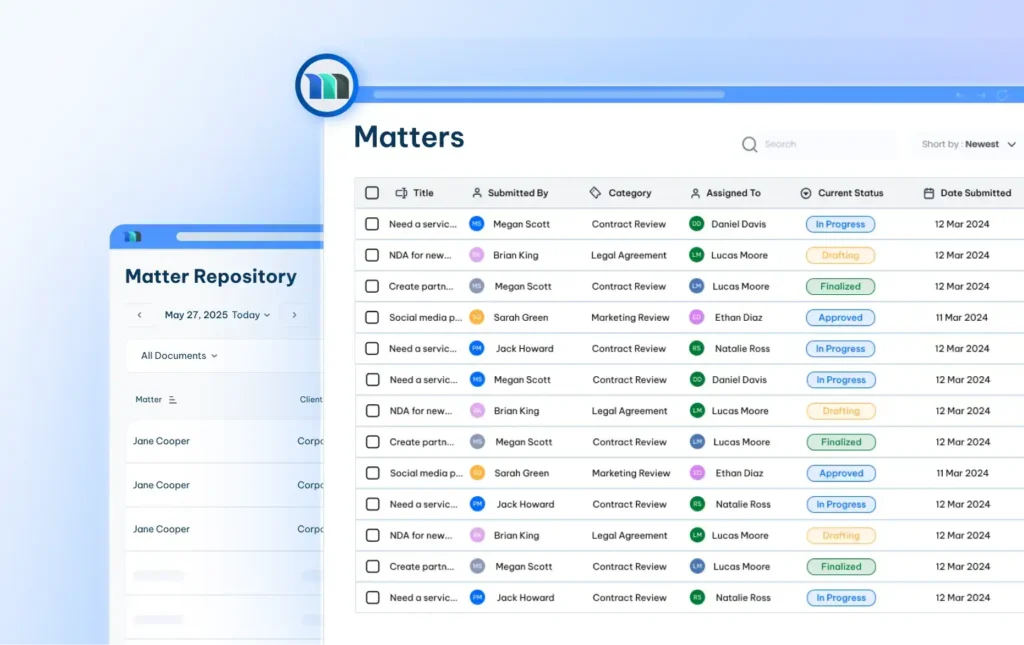
Matter management is the command center of your legal department. It tracks every moving part of your legal operations. It includes things like contract reviews, compliance checks, or any ongoing legal obligations. It keeps evolving and often involves multiple stakeholders. As there is no fixed deadline, work can often be fragmented, making it difficult to track. Collaboration is essential, and hence platforms like MatterSuite are built for this kind of workflow, allowing flexibility while maintaining clarity on ongoing legal matters.
Understanding Case Management
When a matter needs to be escalated into litigation, arbitration, or any court proceeding, it becomes a case, and case management systems enter the picture. The transition from matter to case management is important because cases have rigid deadlines, filings, hearings, and compliance with rules. Unlike matter management, legal case management softwares are more structured with a focus on timely progress. For teams that manage both cases and matters, MatterSuite is one such platform that also supports legal teams when matters escalate into cases, keeping everything within the same system rather than switching tools midstream.
How to Choose The Right Software
After learning the difference between legal matters and legal cases, choosing the right software for your practice becomes easier. Here is a detailed step-by-step approach to finding the tools that align with your legal work:
- Step 1: Identify the kind of legal work you handle the most
If your legal work primarily deals with litigation, a case management system platform will be more suitable for you. It helps you track proceedings, filing, and deadlines. But if your team handles contracts, compliance, and regulatory matters, you would benefit from a matter management system. Teams that manage both cases and matters should opt for matter management tools, which can handle escalation.
- Step 2: Assess how flexible your workflows need to be
Legal work doesn’t follow a linear path. In-house teams need flexibility when it comes to intakes and workflow tracking, while law firms require structure around advisory work and disputes. Tools like MatterSuite provide customizable workflows that adapt to the needs of your case.
- Step 3: Consider visibility and reporting needs
If workload and matter status are important for your firm’s needs, matter management tools provide a clearer view and insights. Case management software, on the other hand, is more focused on tracking case milestones and outcomes. Choosing the right legal matter management software depends on whether your priority is clarity or tracking, or a balance of both.
- Step 4: Think about growth and long-term use
As the legal teams evolve, the software needs to adapt to the changing workflows. This helps in reducing the need for workarounds and system changes. MatterSuite is designed to grow with legal teams,
Conclusion
Legal matters and legal cases are closely related but definitely not interchangeable. Both function very differently in practice. Matters often begin as internal requests or routine legal support with no fixed timelines or external authority involved. They evolve gradually and require inputs from different teams. It may never even reach a formal dispute stage. Legal cases, on the other hand, have to follow strict procedures, with external forums like courts being involved. Because of such differences, managing both using the same approach often leads to friction and confusion.
This is why platforms that are matter-focused fit into the needs of teams with diverse needs. MatterSuite is one such platform that is designed around how legal actually starts and comes to an end. Instead of forcing every request into a structure, it supports the full lifecycle of the legal matters. From intake to resolution, MatterSuite allows matters to escalate into cases as and when required.