

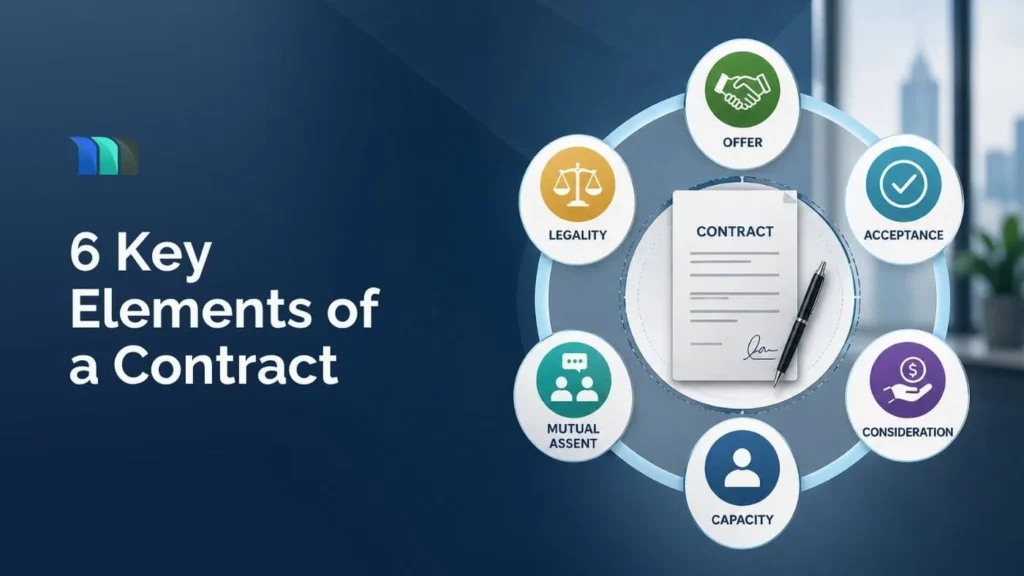
Every contract, no matter how long or complex, is built on the same foundation. A multi-billion-dollar M&A agreement and a two-page vendor NDA are governed by the same basic requirements. Get them right, and the agreement holds. Miss one, and the whole thing can unravel, regardless of how polished the language around it looks.
These requirements have a name: the elements of a contract. And whether you’re drafting your hundredth agreement this quarter or reviewing one on behalf of a client, knowing them cold is what separates a contract that protects you from one that only looks like it does.
What actually is a contract?
A contract is a legally binding agreement between two or more parties that creates mutual obligations enforceable by law. It doesn’t have to be a formal document sealed with signatures. Contracts can be written, oral, or implied through conduct. What makes an agreement a contract, rather than just a promise, is that it satisfies a specific set of legal requirements. If either of the parties misses even one, it may not hold up when it matters most.
The 6 Core Elements of a Valid Contract
Contract law, across most jurisdictions, holds to a consistent set of requirements for an agreement to be legally binding. Missing one can cause it to fall apart when it’s tested. Here are the six:
1. Offer
An offer is a clear, definite proposal where one party expresses to another a genuine willingness to enter into a contract on specific terms. It’s where every contract starts.
To qualify, an offer has to be communicated to the other party, definite enough in its terms that vague expressions of interest don’t make the cut, and made with real intent to be bound upon acceptance.
An offer is not the same as an invitation to treat. A product listing, a price quote, and an LOI (Letter of Intent) invite negotiation. They’re not binding proposals. That distinction gets blurred constantly in commercial contracts, where term sheets and vendor proposals are regularly mistaken for something they’re not.
In practice: A purchase order sent by a buyer to a supplier, laying out price, quantity, and delivery terms, qualifies as an offer. The supplier’s catalog listing those same prices is not.
2. Acceptance
Acceptance is the other party’s unconditional agreement to every term of the offer. Every term. This is what the mirror image rule means: acceptance has to reflect the offer exactly, with no modifications and no new conditions attached.
A few things matter here. Acceptance has to be communicated. It has to be unconditional, because a counteroffer voids the original. It has to happen before the offer expires or is pulled back. And sometimes the offer itself specifies how acceptance must be delivered.
In business contracts, acceptance usually happens at signature. But depending on the agreement and the jurisdiction, it can also happen through conduct, through an email confirmation, or when someone starts performing.
In practice: If a vendor responds to a purchase order and changes the payment terms, that’s a counteroffer, not acceptance. The original offer is void. This is the “battle of the forms” problem. It’s everywhere in procurement, and it causes real disputes.
3. Consideration
Consideration is what each party actually gives up or provides as part of the deal. It’s the thing that separates a binding contract from an unenforceable promise. Money, services, goods, a commitment to act, even a commitment to refrain from acting, all of it can qualify.
Two rules worth keeping in mind: consideration has to be sufficient, but courts won’t second-guess whether the exchange was a good deal. And past consideration, meaning something one party already did before the contract existed, generally doesn’t count.
Without consideration, you don’t have a contract. You have a one-sided promise.
In practice: In a SaaS agreement, the client’s consideration is payment, and the vendor’s is the software. Both sides are bound because both sides gave something.
4. Capacity
Both parties need the legal capacity to contract. That means being of legal age, of sound mind, and not legally prohibited from entering into agreements. Standard enough.
But for corporate contracts, capacity has an additional layer that trips people up: the person signing has to have actual authority to bind the entity. A junior employee signing a multimillion-dollar agreement without authorization creates a capacity problem even if that individual personally has full legal capacity.
In practice: Legal departments without a clear, documented signatory authority matrix (who can sign what, up to what value) are exposed to capacity challenges regularly. It’s one of the most overlooked contract risks in fast-growing companies, and it’s almost entirely preventable.
5. Mutual Assent (Meeting of the Minds)
Both parties need to genuinely understand and agree to the same terms. Signatures aren’t enough on their own. They have to have meant the same thing when they signed.
Mutual assent breaks down in a few specific ways: misrepresentation, fraud, duress or coercion, or a mistake, by one party or both, about something fundamental to the agreement.
In practice: Vague contract language is a mutual assent trap. When a services agreement says deliverables will be completed “in a reasonable time,” two parties can sign in complete good faith while holding completely different expectations. Most disputes that trace back to ambiguous language are, at their core, mutual assent failures.
6. Legality
A contract’s purpose and subject matter have to be legal. Agreements for illegal activities are void from the start. A court won’t touch them, no matter how carefully drafted.
Legality also extends to regulatory compliance. A contract that runs afoul of sanctions law, industry regulations, or public policy can be unenforceable even if the underlying activity isn’t criminal.
In practice: This comes up more than legal teams expect, especially in international contracts where something legal in one jurisdiction is prohibited in another, or in heavily regulated industries like financial services and healthcare, where what parties can contractually agree to is shaped by rules that exist outside the contract itself.

What Makes a Contract Unenforceable?
A contract can check all six boxes and still be challenged. The most common grounds legal teams actually encounter:
Unconscionability
There are times when terms are so one-sided that enforcing them would be fundamentally unfair. This comes up most often in consumer contracts or situations where bargaining power was badly imbalanced.
Failure of consideration
If the promised consideration never materializes, the contract can become unenforceable. It’s why performance milestones exist.
Breach of a condition precedent
Many contracts only become binding when a condition is first met (regulatory approval, financing secured, etc.). If that condition fails, there’s no enforceable agreement.
Statute of Frauds
Certain contracts have to be in writing. Real estate, agreements that can’t be performed within a year, contracts above a certain value — most jurisdictions require these to be written down. Oral agreements for these transactions don’t hold up.
Lack of authority
A contract signed by someone without actual or apparent authority to bind the organization may be voidable, even if every other element is present. This is a risk that surfaces most often in fast-moving deals, where the urgency of closing can quietly override the discipline of checking who actually has the power to sign.
Real-World Scenarios Legal Teams Recognize Immediately
These aren’t hypothetical situations; they happen frequently in in-house teams
Scenario 1: The auto-renewed contract nobody authorized.
A vendor agreement renews automatically because no one was tracking the notice window. The person who originally signed left the company two years ago. Was there ever a proper authority for renewal? Did the renewal create a new offer-and-acceptance situation? Now it’s a mess.
The fix: A contract calendar with renewal alerts and a live record of signatory authority would have caught this before it became a legal question
Scenario 2: The SOW that contradicts the master agreement.
An MSA was signed with clear payment terms. A Statement of Work executed a year later quietly introduced different ones. Which governs? If the parties didn’t have genuine mutual assent on that question, there’s an enforceability problem.
The fix: Every SOW should include an explicit order-of-precedence clause, and any deviation from the MSA should require a formal amendment, not a buried line in a new document.
Scenario 3: The NDA signed by an intern.
Small company, fast-moving deal. Someone signs an NDA with a Fortune 500 counterparty without any authority to do so. The company later tries to enforce it and discovers the signatory couldn’t bind the entity. The protection they thought they had may not exist.
The fix: A documented signatory authority matrix, even a simple one, ensures the right person signs every agreement, regardless of how fast the deal is moving.
Scenario 4: When the LOI is treated as a binding contract.
A startup takes an LOI as binding and starts performing. The other party walks. Whether the LOI was a binding offer or merely an invitation to keep negotiating becomes the entire dispute.
The fix: LOIs and term sheets should explicitly state whether they are or aren’t binding, and legal should review them before anyone starts performing against them.
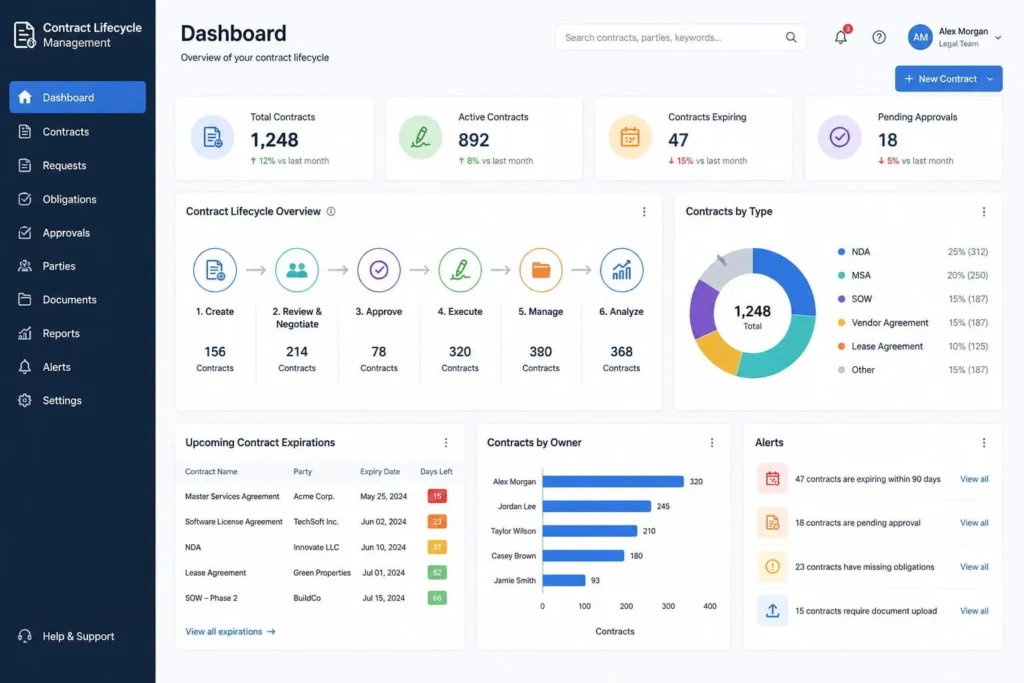
How CLM Software Catches What Humans Miss
Understanding the six elements is one thing. Making sure every contract that flows through a legal department actually contains them, especially when you’re managing hundreds or thousands of agreements, is something else entirely.
This is where Contract Lifecycle Management (CLM) Software earns its place. Modern CLM platforms help legal teams operationalize the fundamentals in a few concrete ways.
Automated clause detection
CLM tools scan incoming contracts and flag when key elements are absent or non-standard — missing consideration language, unclear acceptance mechanics, or no governing law provision. Not every third-party paper needs a lawyer’s eyes before it gets escalated.
Signatory authority workflows
Instead of relying on institutional knowledge about who can sign what, CLM systems enforce approval workflows that match your authority matrix. The wrong person simply can’t push a contract through without the right sign-off.
Obligation and condition tracking
Conditions precedent, renewal notice windows, payment milestones, and other performance obligations that determine whether a contract stays enforceable get tracked, flagged, and reported on systematically rather than buried in a folder nobody checks
Audit trails
When a contract’s validity gets questioned, the CLM’s time-stamped record of offer, negotiation, redlines, and acceptance creates exactly the evidence needed to establish or defend mutual assent.
Risk scoring
Enterprise CLM platforms increasingly use AI to score contracts against your organization’s legal standards, surfacing capacity gaps, unusual indemnification terms, or missing elements before they turn into disputes.
The Fundamentals Are the Foundation
The six elements of a contract (offer, acceptance, consideration, capacity, mutual assent, and legality) aren’t abstract legal theory. They’re the checklist that stands between your organization and an unenforceable agreement. Every contract your team touches should satisfy all six. Every system your team builds should make that easier to confirm.
Knowing the elements is the starting point. In a legal department managing real volume, it’s only half the battle. The other half is making sure nothing slips through. That’s exactly what MatterSuite is built for. Whether you’re a three-person legal team trying to get ahead of a growing contract load or a 50-attorney firm advising clients on contract risk, MatterSuite gives you the tools to manage every agreement from draft to renewal, with the visibility and control to make sure the fundamentals never get missed.