

- Every business runs on contracts, and yet most of them have no consistent process for managing them, leading to delayed deals and compliance gaps that accumulate over time.
- Contract lifecycle management (CLM) is how businesses bring order to their contracts, making sure every agreement is properly drafted, approved, executed, and tracked.
- Organisations with a structured CLM process in place consistently report faster contract cycles, lower administrative costs, and better control over their obligations across the business.
What Is Contract Lifecycle Management?
Contract lifecycle management (CLM) is the process or a set of processes involved in managing a contract from the time it is requested until it is renewed or ends. It includes drafting the contract, negotiating, getting approval from the parties involved, executing the contract, and finally closing or renewing it. A good CLM process does three things for in-house legal teams: it lowers risk, speeds up the signing of contracts, and offers clear visibility over your active agreements.
CLM for in-house legal teams
In-house legal teams handle high contract volumes with limited resources, making generic tools inefficient. Tailored CLM focuses on their unique needs: rapid approvals for business deals, built-in compliance for multi-jurisdictional work, and obligation tracking to prevent lapses. Unlike law firm systems, it prioritizes self-service portals for non-legal users, reducing legal bottlenecks while maintaining oversight.
Why Contract Lifecycle Management Matters?
Legal complexity alone doesn’t usually cause contracts to fail. They break down more often because of how they are run on a daily basis. Without a clear system, it can be hard to keep track of contracts, which can cause delays, missed obligations, and inefficiencies.
A 2024 study by Deloitte and DocuSign found that bad contract management costs businesses around the world almost $2 trillion in economic value every year.
Many companies have contracts that are stored in more than one system. Teams spend hours looking for the most recent version, approvals take longer because of long email threads, and important dates like renewals or expirations are easily missed. Over time, these problems get worse, which can cause lost sales, compliance issues, and strained business relationships.
This is the problem CLM solves. It is not just a storage system. It includes the workflows, approvals, obligations, and renewal milestones that make sure contracts are up to date and in compliance. In the legal field, CLM means using this process to make sure that the legal team properly reviews, approves, executes, and tracks every agreement a company makes.
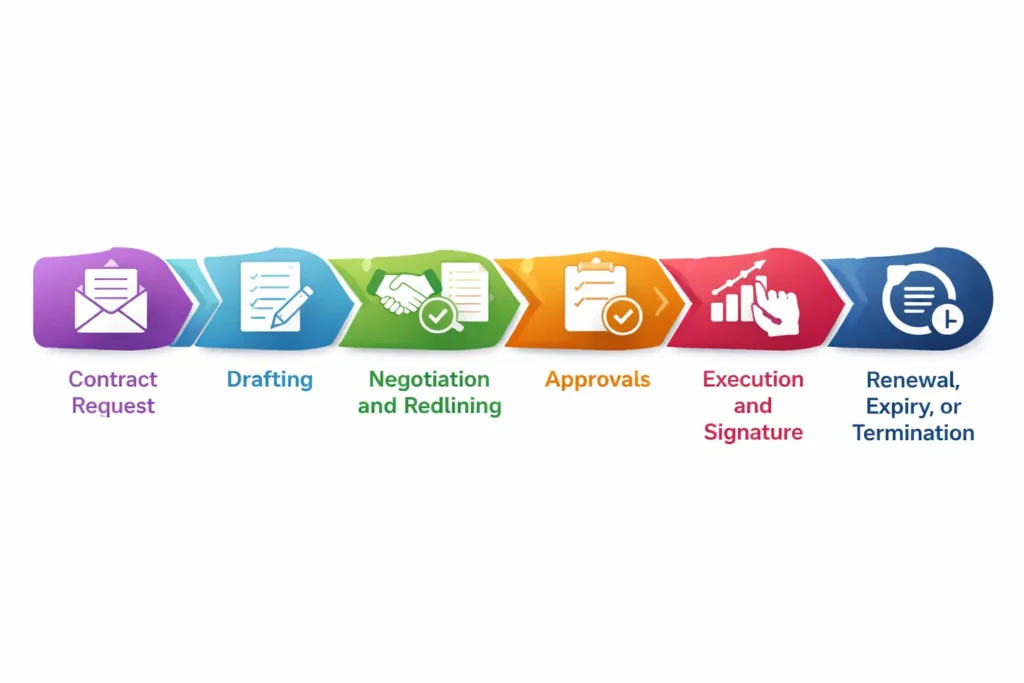
The 7 Key Stages of Contract Life Cycle
Every contract follows the same journey, from the initial request through to renewal, expiry, or termination. Understanding each stage is the foundation of managing contracts well.
Stage 1: Contract Request
The process begins when a business team identifies the need for a contract, whether a vendor agreement, an NDA, or an employment contract. They submit the key details: contract type, counterparty, and main business terms. A CLM system captures these requests consistently and routes them to the right people, removing the need for manual follow-up.
Stage 2: Drafting
With the request in hand, legal teams draft the contract using pre-approved templates and clause libraries. Rather than starting from scratch each time, they select the right template, fill in the specifics, and adjust where needed. What previously took days can be completed in a matter of hours.
Stage 3: Negotiation and Redlining
Most contracts go through several rounds of review before both sides agree on final terms. Parties suggest changes, push back on clauses, and propose alternative language. In a CLM system, every version is tracked automatically, so there is always a clear record of what changed, who made the change, and when.
Stage 4: Approvals
Before execution, a contract typically needs sign-off from multiple stakeholders across legal, finance, procurement, or senior leadership. A CLM platform routes the contract through the appropriate approval chain based on contract type or deal value, keeping the process moving without manual coordination.
Stage 5: Execution and signature
Once approved, all parties sign the contract. CLM platforms integrate with e-signature tools to make this step seamless. The executed document is stored automatically in a central repository, and the contract becomes legally binding from this point forward.
Stage 6: Obligation Tracking
A signed contract is not the end of the work. Most agreements contain ongoing obligations such as payment milestones, deliverables, notice periods, and service levels. Missing these can lead to penalties, disputes, or damaged business relationships. CLM tracks all active obligations and sends automated alerts before key dates arrive.
Stage 7: Renewal, Expiry, or Termination
Every contract has an end date. CLM systems flag upcoming renewals well in advance, giving legal teams time to assess whether to renew, renegotiate, or let the contract expire. Without this visibility, critical agreements can lapse without anyone realizing it until problems arise.
What Is CLM Software?
Contract Lifecycle Management (CLM) Software is a digital platform with tools that manage and automate the entire contract lifecycle process, right from its first draft to its renewal or expiry. Instead of using separate tools for drafting, approvals, tracking, and storage, CLM software handles everything, bringing every stage of the contract lifecycle into one connected system.
A CLM software is built to solve three fundamental problems: contracts are hard to find, easy to mismanage, and time-consuming to process. A CLM system addresses all three by centralising storage, automating routine tasks, and making the process transparent for stakeholders, allowing them to know where a contract stands and what action is needed.
Challenges of Contract Lifecycle Management
Even with the best intentions, in-house legal teams often face hurdles in managing contracts effectively. Below are the top challenges and their impacts.
- Manual Workflows Create Bottlenecks
Relying on emails and Word docs for drafting, reviews, and tracking leads to repetitive tasks, human errors, and significant delays, especially under high contract volumes. - Lack of Transparency
Without a unified platform, stakeholders in legal, finance, and operations struggle to track contract status, causing miscommunication and duplicated efforts. - Struggles with Compliance and Regulations
Evolving laws and industry standards demand constant vigilance, but manual checks leave teams vulnerable to non-compliance fines, audits, and penalties. - Tracking changes and revisions
During negotiations, redlines and revisions pile up across emails, making it hard to identify the latest draft or changes, fueling disputes and rework. - Security and Data Risks
Sensitive contract data stored in unsecured folders or drives exposes organizations to breaches, leaks, and regulatory violations like GDPR or CCPA
Benefits of Contract Lifecycle Management
Faster contract cycles
Automated templates and approval workflows reduce the time it takes to go from request to signed contract. What used to take weeks can happen in days.
Reduced legal risk
Standardized language, proper review workflows, and obligation tracking mean fewer things fall through the cracks. Legal teams have full visibility into what has been agreed to.
Better compliance
CLM systems track every obligation in every contract. Automated alerts ensure that payment dates, notice periods, and regulatory requirements are never missed.
Cost savings
Fewer manual hours on contract admin means lower operational costs. Catching missed renewals or unfavorable auto-renewal clauses can also save significant money.
Stronger negotiation
When legal teams have access to a clause library and data on past contracts, they know what the company has accepted before and where to push back.
Centralized visibility
A single repository means that anyone with the right access can find any contract instantly, without digging through email threads or shared drives.

Key Metrics for Measuring Contract Performance
Knowing your CLM process is working requires more than a general sense that things are running smoothly. These are the metrics in-house legal teams should track to measure contract performance.
Contract cycle time
The contract lifecycle is the time required to execute an agreement, from the moment the request is received. This is the single most telling metric for how efficient your contract process is.
Approval turnaround time
The time taken by contracts for internal sign-off is known as approval turnaround time. If this number is high, the issue is usually either too many approval steps or approvers who are not being notified effectively.
Renewal rate
The percentage of contracts that are actively renewed versus those that lapse or auto-renew by default. A low intentional renewal rate suggests the team lacks the visibility to make proactive decisions before expiry.
Contract deviation rate
The percentage of contracts that include non-standard clauses or deviate from approved templates. A high deviation rate increases legal risk and slows down the review process. Tracking it helps legal teams identify where standard language needs to be strengthened or where business teams need more guidance.
Obligation compliance rate
The percentage of contractual obligations that are met on time (payment milestones, deliverables, notice periods, and service levels) is known as the obligation compliance rate. Missed obligations are often where disputes begin, making this one of the most important metrics to track.
Contract value at risk
The total value of contracts with upcoming renewals, expiring terms, or unresolved obligations. This gives legal and finance leadership a forward-looking view of where attention is needed before problems arise.
CLM Best Practices for In-House Legal Teams
Having a CLM system in place is a starting point. Getting the most out of it requires a set of practices that keep the process consistent, scalable, and effective over time.
Build and maintain a living clause library
A clause library is only valuable if it is kept current. Assign clear ownership for reviewing and updating standard clauses on a regular basis, or whenever there is a significant regulatory or business change.
Identify the risk level of your contracts
Not every contract needs the same level of scrutiny. A low-value NDA does not require the same review process as a multi-year enterprise agreement. Tiering contracts by risk and value allows legal teams to focus their attention where it matters most, while routine agreements move through a lighter, faster process.
Use data to improve the process over time
The metrics your CLM system generates are not just for reporting. They are a tool for continuous improvement. If cycle times are long, look at where contracts are getting delayed. If the deviation rate is high, investigate why business teams are pushing for non-standard terms. Let the data guide where the process needs to change.
Involve other teams early
Legal teams that treat CLM as a legal-only system miss much of its value. Procurement, sales, finance, and HR all interact with contracts regularly. Bringing these teams into the system improves adoption, reduces workarounds, and gives everyone the visibility they need to do their jobs effectively.
Real-World Scenarios: CLM across different businesses
CLM means different things to different teams. The best way to understand its value is to see it applied to situations that actually happen in business every day.
Scenario A: The Retail Chain Drowning in Supplier Contracts
A retail company works with 500+ suppliers, each with different payment terms, SLAs, and renewal windows, all tracked on spreadsheets. When a supplier misses a delivery commitment, no one can locate the penalty clause. When contracts expire, the team finds out only after auto-renewal has kicked in.
Where CLM helps: A centralised repository makes every supplier contract searchable instantly. Automated alerts flag renewals weeks in advance. Obligation tracking surfaces penalty clauses without anyone digging through PDFs.
Scenario B: The Legal Team at a Healthcare Provider
A hospital network’s legal team manages contracts with device vendors, insurers, and staffing agencies, all carrying strict compliance requirements. They currently track everything through a shared inbox. A missed obligation or lapsed agreement can mean serious regulatory exposure.
Where CLM helps: Compliance-driven workflows ensure every contract goes through the right review steps. Audit trails give legal a complete record of who approved what and when. It proves invaluable if a regulatory query arises.
Scenario C: The HR Team Issuing Hundreds of Employment Contracts a Month
A fast-growing company is sending offer letters manually, getting signatures over email, and storing contracts in shared folders. Wrong versions get sent. Candidates lose patience. When an employment dispute arises, HR cannot produce a clean, signed copy quickly.
Where CLM helps: Template-driven generation means a contract can be produced and sent for e-signature in minutes. Version control ensures the right document goes out every time. Any contract can be retrieved instantly when needed.
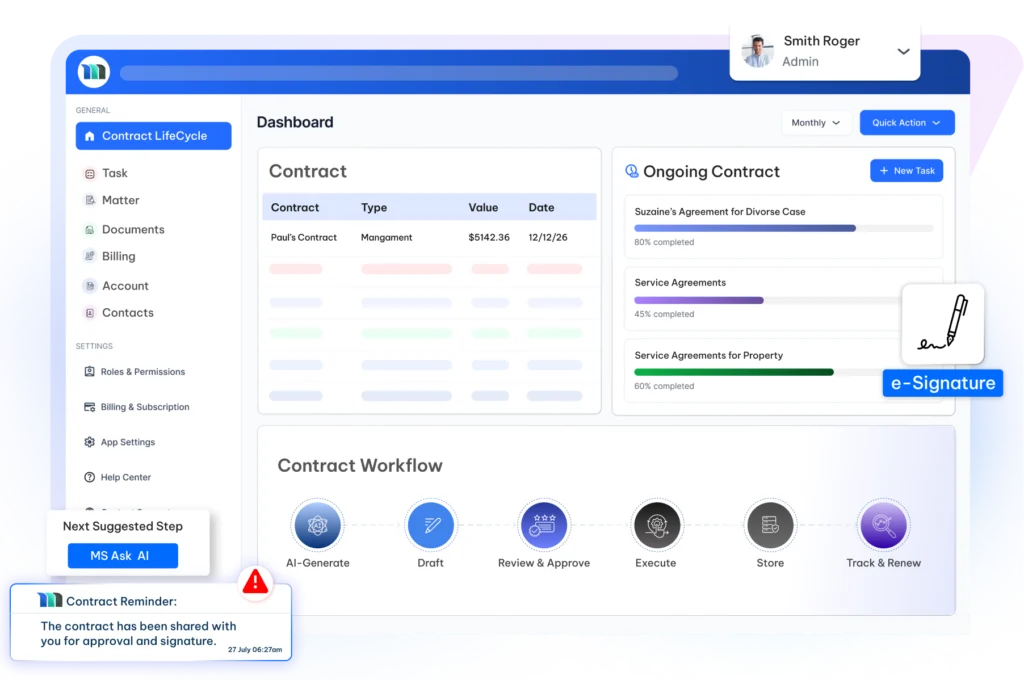
How MatterSuite CLM helps
In-house legal teams are often the smallest, most stretched function in a business, and yet every contract in the organisation passes through them. MatterSuite CLM is built keeping that reality in mind. Rather than adding complexity, it gives legal teams a straightforward system to draft, review, approve, and track contracts without the overhead of a heavy enterprise tool.
Here is what that looks like in practice:
Contract Templates: Build and manage reusable templates for your most common agreements. Smart placeholders pull in client details, matter numbers, fees, and jurisdictions automatically, so no one is filling in the same fields manually every time.
Clause Library: Maintain a centralised bank of pre-approved language covering payment terms, confidentiality, liability, and more. Any clause can be dropped into a contract in seconds, keeping agreements consistent across the board.
Redlining and Version Control: Teams can redline contracts, negotiate terms, and track every change made throughout the review process. A complete version history means nothing is ever lost. Compare any two drafts side by side or roll back to an earlier version instantly.
Audit Trail: Every edit, approval, and review is logged against the user who made it, complete with timestamps. When accountability matters, the record is always there.
Access and Permissions: Define who can edit clauses, use templates, and approve contracts. Different roles get different levels of access, so sensitive agreements are only in the hands of the right people.
Approval Workflows: Route contracts through the right approval path automatically based on value and risk. Routine agreements move quickly while high-value contracts follow a more rigorous review process, with automated alerts keeping everyone on track.
E-Signatures and Storage: Send contracts for signature without leaving the platform. Once signed, everything (the PDF, timestamp, and completion certificate) is stored and retrievable in one place.
Reporting Dashboard: A single view of contract status, upcoming renewals, expiry alerts, and approval bottlenecks, giving legal leadership the visibility to stay ahead of what is coming.
Conclusion
The way businesses manage contracts is changing. Manual processes that were once considered good enough are now a measurable drag on productivity, revenue, and risk management. CLM has moved from being a nice-to-have for large enterprises to a practical necessity for any organisation that takes its contracts seriously, regardless of size or industry.
It brings clarity to each stage, reduces manual effort, and ensures that nothing important gets missed. From faster approvals to better compliance and visibility, the impact is both immediate and long-term.
As your business grows, so does the complexity of your agreements. Relying on multiple systems and manual processes only makes things harder to manage. Putting the right CLM process in place gives you control and efficiency, and equips you with the ability to make better decisions with every contract you sign.